How Performance Marketing Helps Solar Businesses Scale
Introduction: Why Lead Generation Is Critical for Solar Businesses Solar is a demand driven business. More people are actively looking for solar panels, battery storage, and electricity bill savings today than ever before. But in the real market,…
01Introduction: Why Lead Generation Is Critical for Solar Businesses
Solar is a demand driven business. More people are actively looking for solar panels, battery storage, and electricity bill savings today than ever before. But in the real market, demand alone does not guarantee sales.
Many solar business owners assume that if pricing is competitive and the product is good, installations will automatically grow. In reality, growth depends heavily on one factor: a consistent and predictable lead pipeline. Without steady leads coming in every week, even the best sales team cannot deliver stable results.
This is why many solar retailers and installers struggle not because their service quality is poor or their pricing is wrong, but because their lead sources are unstable. Some weeks they get strong inquiries, and other weeks the lead flow drops suddenly. This creates pressure on revenue, creates uncertainty in operations, and makes it difficult to plan hiring, inventory, and expansion.
To truly scale a solar business, you need more control over lead generation. That means having marketing channels that can be measured, optimised, and scaled based on performance. In the next sections, we will break down common lead sources solar businesses use today and explain why performance marketing has become one of the most reliable ways to grow consistently.
02Common Lead Generation Sources Used by Solar Businesses
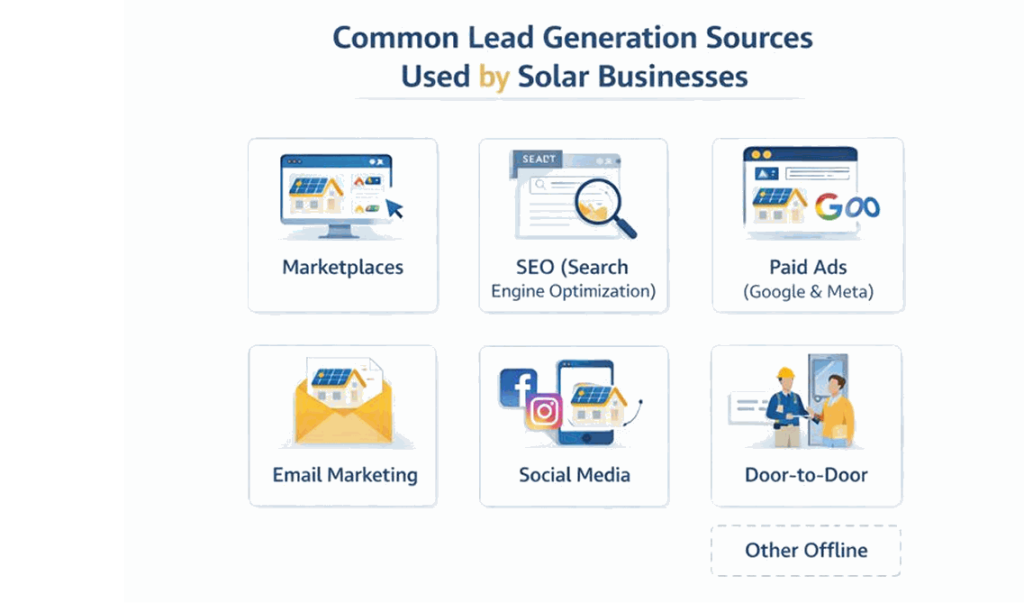
Most solar businesses do not rely on only one lead source. In practical terms, solar leads come from a mix of online and offline channels. Some sources work well for steady inquiries, while others bring leads only occasionally.
However, the major challenge is this: not every lead source supports scaling. A channel may generate leads, but if it is inconsistent, expensive, or difficult to control, it becomes hard to grow the business predictably.
Online and Offline Lead Sources in Use Today
Marketplaces: Many solar retailers use marketplaces or aggregator platforms to get inquiries quickly. These platforms can bring volume, but leads are often shared with multiple vendors and become highly price-driven.
Email marketing: Email campaigns can help with follow-ups and remarketing, but for solar purchases, cold email rarely generates direct conversions. It works better for nurturing leads who have already shown interest.
SEO (Search Engine Optimisation): SEO can deliver quality leads at a lower long-term cost. But it takes time to build rankings and results are not immediate. It is a strong channel for stable growth, but not always reliable for fast scaling.
Social media: Facebook and Instagram help build trust and awareness. Solar businesses often get some inquiries through content and engagement, but lead intent may be mixed unless supported by ads and clear offers.
Paid ads (Google & Meta): Paid advertising is one of the fastest and most scalable lead sources. Google Ads captures high-intent users searching for solar solutions, while Meta Ads can generate volume and awareness. When managed properly, paid ads give strong control over targeting and lead flow.
Door-to-door (D2D): Many solar companies still use D2D sales for local lead generation. It can work well in specific areas, but scaling requires manpower, training, and operational effort making it difficult to expand quickly without high costs.
Each of these channels has a role. But for solar businesses aiming to scale, the focus should be on sources that offer control, predictability, and measurable performance. That is where performance marketing becomes important.
03Lead Quantity vs Lead Quality – The Real Solar Business Problem
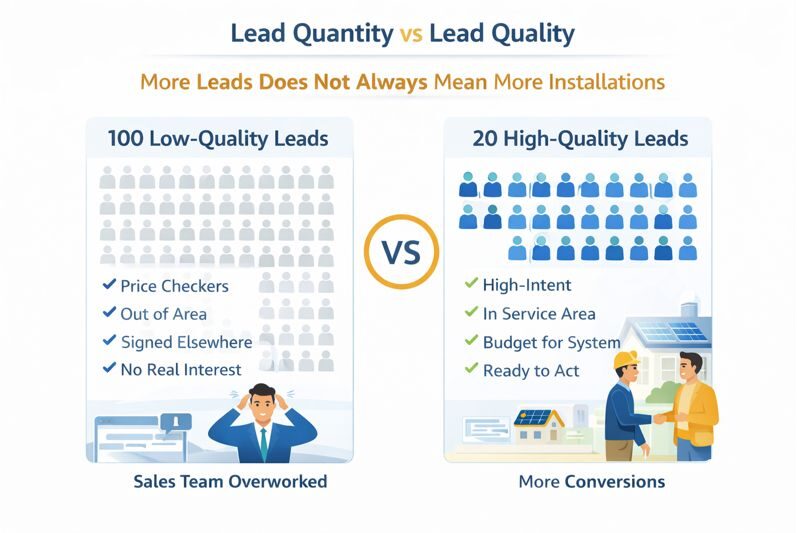
In solar marketing, many businesses focus only on one metric: number of leads. More leads may look good on reports, but in reality, more leads do not always mean more installations.
Solar is a high-consideration purchase. Customers compare prices, check subsidy eligibility, ask multiple vendors, and take time to decide. If your lead pipeline is filled with low-intent or irrelevant inquiries, your sales team stays busy but conversions remain low.
This is where the real problem starts: solar businesses don’t suffer due to lack of leads. They suffer due to lack of quality leads.
Why More Leads Do Not Always Mean More Installations
A large lead volume often includes:
People only checking prices without serious intent
Inquiries from outside your service area
Customers who already signed with another vendor
Leads looking for government scheme details, not installation
Even if your marketing generates 200 leads in a month, it may not deliver more installations if those leads are not the right fit.
The Hidden Cost of Low-Quality Leads
Low-quality leads do not just waste ad spend they waste operational time.
Common issues solar sales teams face when lead quality is low:
Too many follow-ups: Calls, messages, and reminders with no response
Long sales cycle with weak intent: Prospects keep delaying decisions
Sales fatigue: Team motivation drops when closure becomes difficult
Lower productivity: High-intent leads get less attention because the team is overloaded
Over time, this affects the entire business conversion rates fall, sales teams burn out, and growth becomes unpredictable.
What Really Defines a “Good Solar Lead”
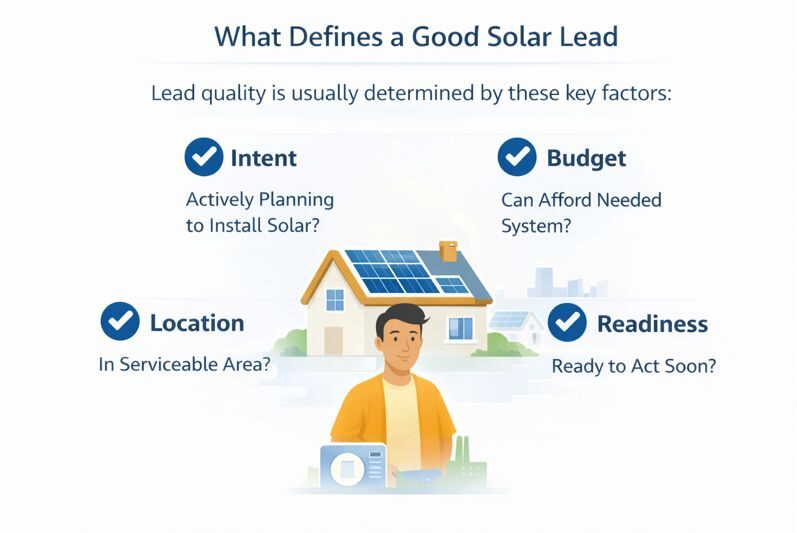
For solar businesses, lead quality is usually determined by four key factors:
Intent: Are they actively planning to install solar, or just exploring?
Location: Are they within your serviceable area?
Budget: Can they afford the system size they need?
Readiness: Are they ready to take action within weeks, not months?
When these factors align, the lead converts faster and requires less effort from the sales team.
This is why scaling a solar business is not about chasing higher lead volume. It is about generating better-quality leads consistently so each lead has a higher chance of turning into an installation.
04Evaluating Lead Sources Based on Real-World Results
When solar business owners talk about lead generation, the discussion often becomes theoretical: “SEO is good”, “marketplaces give leads”, “Meta is cheap”, “Google is expensive”, etc.
But in real operations, lead sources should be judged only on one thing: what results they deliver on the ground.
For example, a lead source may generate a low CPL, but if those leads rarely convert into site visits, quotations, or installations, the channel is not actually profitable. On the other hand, a channel may look expensive in terms of CPL, but still deliver better ROI if lead intent is high and conversions are strong.
Here’s a simple real-world solar example:
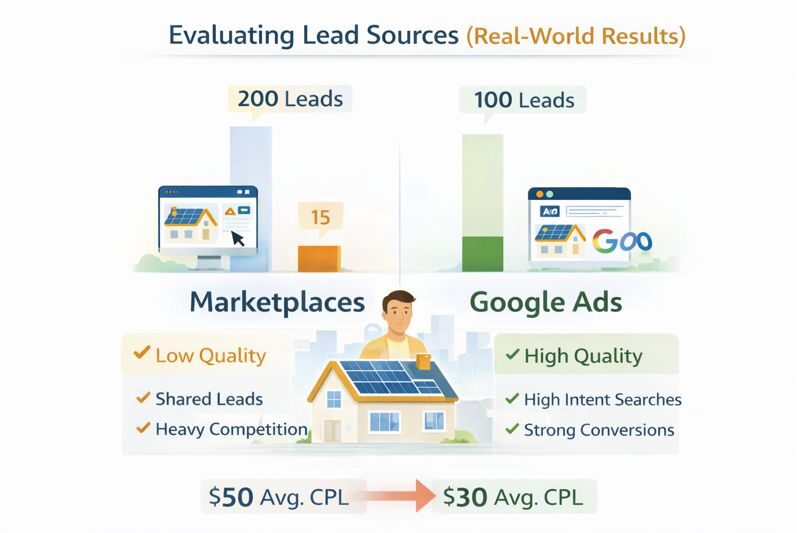
Marketplaces: 100 leads/month, but most are shared and price-focused → may result in only 1 or 2 installations
Google Search Ads: 30 leads/month, but higher intent and better fit → may result in 6–8 installations
This is why lead volume alone is not a strong success metric. What matters is how many leads actually move forward (site visit, quotation, closure).
A practical example of this can also be seen in Google Ads performance benchmarks. In its Google Ads industry benchmark study, WordStream reports that the average conversion rate for Search ads (around 3.75%) is significantly higher than Display ads (around 0.77%). This supports a common real-world observation in solar marketing: Search-based leads usually convert better because users are actively looking for solutions.
This is why solar businesses should not judge performance only by lead count or CPL. Instead, the evaluation should include lead intent and business outcomes such as:
Which source gives leads that are actually within our service area?
Which leads are willing to share electricity bills and roof details?
Which channel gives more site inspections and quotations?
Which source delivers more confirmed installations?
Another reason performance channels like Google Ads matter is because they are measurable. Google highlights this in its Economic Impact methodology, where it explains how advertising tools can be tracked and evaluated based on real output and value, not assumptions. For solar businesses, this matters because scaling needs predictable systems where you can measure spend, lead flow, and conversion outcomes consistently.
This practical approach helps solar businesses stop chasing vanity metrics and start focusing on channels that support stable growth. In the next section, we will break down which lead sources typically deliver better quality and which ones commonly struggle with conversion.
Lead Sources That Deliver Better Quality
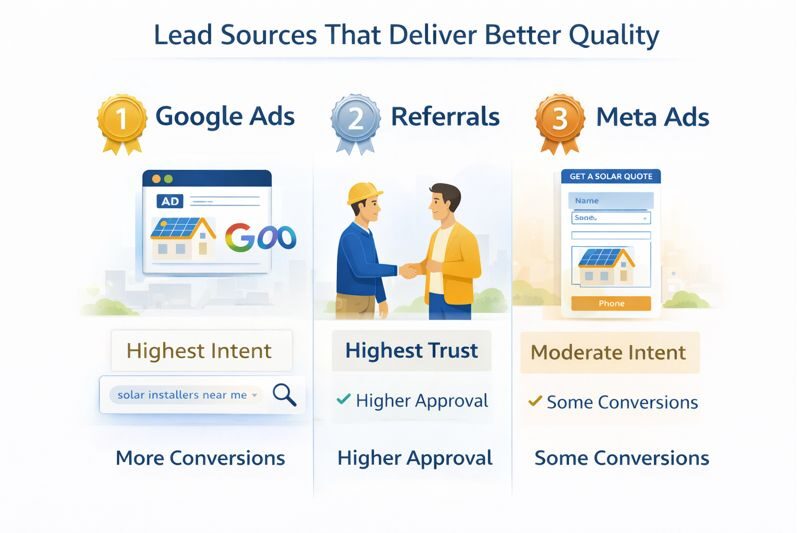
Not all lead sources perform equally in the solar industry. Some channels consistently bring higher intent inquiries that convert into site visits and installations, while others create lead volume but low closure rates. Below are the lead sources that typically deliver better quality in real world solar businesses.
Google Ads:
Most widely used by solar businesses because it can generate leads quickly and consistently
Captures high-intent users actively searching for solutions like “solar panels near me”, “solar company”, “solar + location”, etc.
Offers better control over geography (service areas), keywords, and cost per lead
In short, Google Ads works best when you want leads from people who already have intent and are close to taking action.
Social Media Ads (Meta):
Lead quality is usually moderate compared to Google Search
Works well when pricing is clear and the offer is easy to understand
Best results come when product-market fit is strong (for example: strong savings pitch, subsidy clarity, EMI options)
Requires strong filtering through ad messaging, lead form questions, and follow-up systems
Meta Ads can scale lead volume, but without filtering, it often brings curiosity-driven leads who are not ready to buy.
Referrals:
One of the highest-quality lead sources for solar businesses
Referral leads usually have higher trust and faster decision-making
But referrals are not scalable or predictable
This is why referrals are excellent for stability, but they cannot be the only source for business growth.
Door-to-Door (D2D):
Can work well in local areas and specific neighbourhoods
Quality can be good when the pitch is strong and the team is trained
However, scaling requires manpower, training, daily tracking, and high operational effort
Difficult to scale consistently across multiple locations
D2D is an execution-heavy channel. It can generate results, but scaling becomes operationally challenging.
TV & Offline Advertising:
Delivers high visibility and trust, especially in regional markets
But it is very expensive compared to digital channels
Hard to track ROI accurately because lead attribution is unclear
Offline advertising works best for large solar brands, but it is not practical for most retailers who need measurable growth.
Lead Sources That Struggle With Quality
Some lead sources bring inquiries regularly, but lead quality tends to be low. These channels often require high follow-up effort, and conversion rates are usually weak.
Marketplaces:
Leads are often shared and sold to multiple solar vendors
Customers become highly price-focused and compare aggressively
Low intent and low loyalty to any one installer
High follow-up effort with low conversion rate
Marketplaces may increase lead volume, but they rarely support high-quality scaling unless pricing is extremely competitive.
Email Marketing:
Low engagement when targeting cold audiences
Works better for nurturing leads already in your database (existing inquiries, past customers, referrals)
Very few direct conversions for solar purchases from cold email alone
Email marketing supports long-term trust-building, but it is not a strong primary lead generation channel for solar installations.
05Why Most Solar Businesses Struggle to Scale With These Sources
Most solar businesses use a mix of lead sources like marketplaces, referrals, social media, and offline activity. These channels can generate inquiries, but scaling becomes difficult because they do not provide consistent control over lead quality and lead flow.
In practical terms, solar businesses struggle to scale not because they are doing everything wrong, but because many of their lead sources are external and unpredictable.
Dependence on Third-Party Platforms
When a large part of your leads comes from marketplaces or aggregator platforms, your business depends on a third party for growth. These platforms control:
How leads are generated
How leads are distributed
How many competitors receive the same lead
This creates a situation where your lead flow is not fully in your hands. Even if your service is good, the platform can change pricing, rules, lead volume, or ranking anytime directly impacting your business.
No Control Over Intent or Timing
Many channels generate inquiries without confirming buyer intent. For example, a solar lead may inquire simply to:
Compare prices
Understand subsidy schemes
Check whether solar is possible on their roof
These leads may not be ready to buy. Without control over intent, the sales team ends up spending time on prospects who are still far from decision-making.
The problem is not only intent, but also timing. A lead today does not always mean a sale this month. In solar, timing plays a big role-customers may delay for months if they are unsure, waiting for a budget, or waiting for approvals.
Lead Flow Is Inconsistent
Another major reason solar businesses struggle to scale is inconsistency.
Referrals may bring great leads but they can’t be planned. D2D depends on manpower and daily effort. Social media leads fluctuate based on content and reach. Marketplaces can suddenly increase or reduce lead volume.
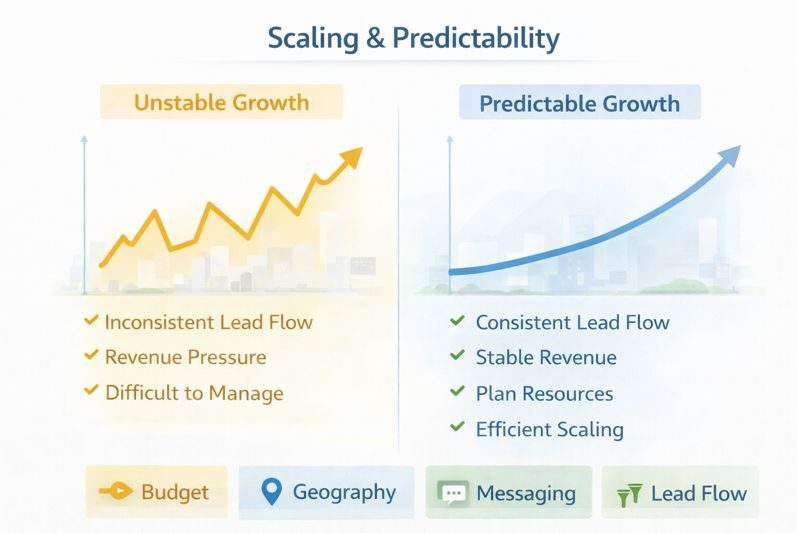
This inconsistency creates growth instability, such as:
Strong sales in one month, weak pipeline in the next
Difficulty managing sales team productivity
Revenue uncertainty and operational stress
Difficult to Forecast Growth
When lead sources are unstable, forecasting becomes nearly impossible. Solar businesses cannot confidently plan:
Hiring and team expansion
New branch or location launches
Vendor tie-ups and supply planning
This is why scaling becomes challenging. Growth requires predictability, and predictability comes only when lead generation is measurable and controllable.
That is the natural transition point where solar businesses start moving towards performance marketing because it offers controlled targeting, measurable outcomes, and the ability to scale lead flow step by step based on ROI.
06What Performance Marketing Means for Solar Businesses
Performance marketing is often misunderstood as “running ads”. But for solar businesses, performance marketing means something more practical: marketing where you pay for measurable outcomes, not just visibility.
For example:
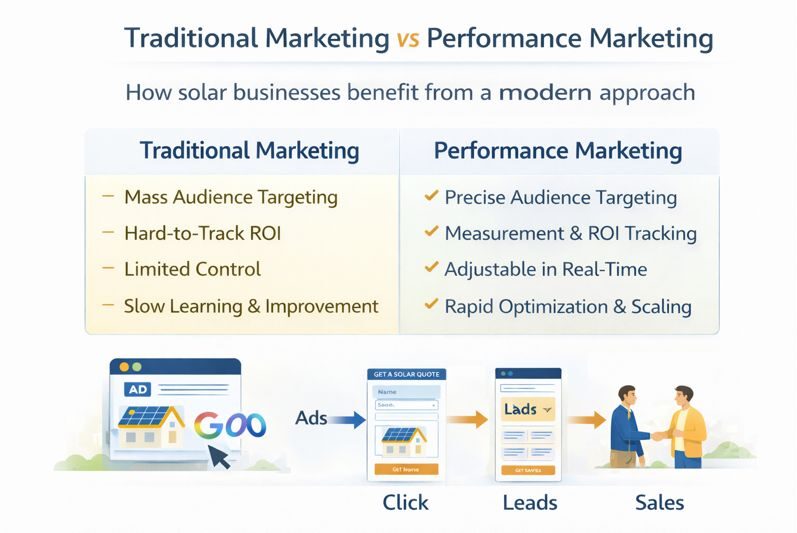
In traditional marketing, you may pay for a newspaper ad, a banner, or a local TV spot without knowing exactly how many leads or installations came from it.
In performance marketing, you spend a budget only with clear tracking such as: how many people clicked, how many submitted a form, how many calls were received, and how many genuine leads came in.
This approach helps solar businesses grow with better predictability because decisions are based on data, not guesses.
What Performance Marketing Focuses On
For solar businesses, performance marketing mainly focuses on three core elements:
Intent: Reaching people who are actively looking for solar solutions (for example, searching “solar panel installation near me” or “reduce electricity bill solar”).
Measurable outcomes: Tracking real actions such as lead form submissions, quote requests, WhatsApp clicks, and phone calls.
Cost control: Managing budget based on performance, pausing what doesn’t work, and scaling what delivers good-quality leads.
The biggest benefit is that performance marketing gives solar businesses a way to improve ROI consistently. If lead quality is low, you can refine targeting. If cost per lead is high, you can improve landing pages and keyword strategy. This is exactly what makes scaling possible.
Traditional Marketing vs Performance Marketing (Solar Context)
To make this simpler, here’s how the difference looks in the solar business:
Traditional marketing: Focuses on reach and visibility. You may get brand awareness, but results are difficult to track clearly.
Performance marketing: Focuses on lead generation and conversions. You measure outcomes and optimise continuously to improve results.
For example, if a solar company runs a local newspaper ad, it may create some awareness but it is difficult to know whether it generated 5 leads or 50 leads. On the other hand, if the company runs Google Ads with proper conversion tracking, it can see exactly how many inquiries came from each location and keyword.
Why Google and Meta Are Core Performance Channels
Most solar performance marketing is built around two channels: Google Ads and Meta Ads (Facebook & Instagram).
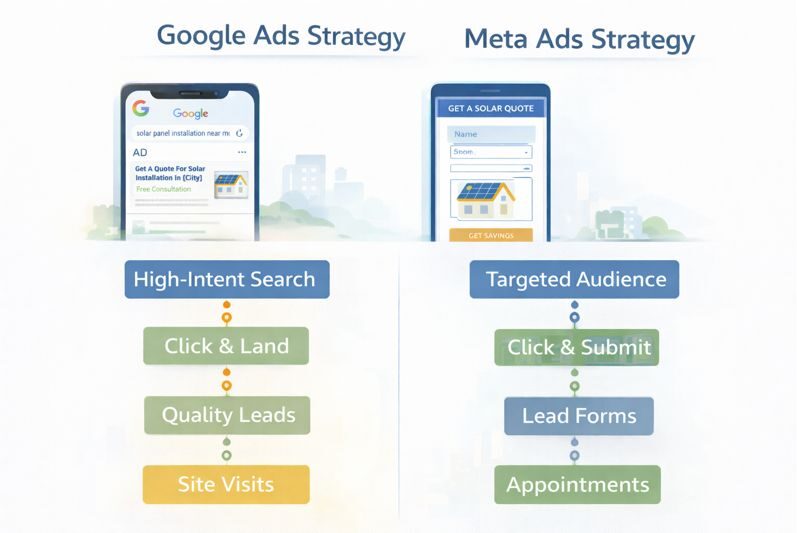
Google Ads: Works best for capturing existing demand. People are already searching, and you simply appear at the right time with the right offer.
Meta Ads: Works well for demand creation and awareness. You can target homeowners and local audiences and generate interest, especially with strong offers and clear messaging.
When used together, these channels create a strong system: Google captures buyers who are already ready, while Meta helps build awareness and keeps your brand in front of the right audience. This combination is one of the most reliable ways solar businesses can scale lead generation in a measurable and controlled way.
07Google Ads Strategies That Help Solar Businesses Scale
Google Ads is one of the strongest channels for solar businesses because it captures high-intent demand. Unlike social media, Google users search when they already have a need, meaning the chance of conversion is much higher.
Targeting Demand That Already Exists
Solar businesses scale faster when they target people who are already looking for solar solutions. This is called search-based intent.
Examples of high-intent searches:
“solar installation near me”
“rooftop solar price”
“solar subsidy in [city]”
“3kw solar system cost”
Google Ads also allows location-specific targeting, which is important because solar installation is service-area based. For example, a solar business in Pune can run ads only for Pune and nearby service locations instead of wasting budget across Maharashtra.
Service-focused keywords also help bring better quality leads, like:
“commercial solar panel installation”
“residential rooftop solar installer”
“solar inverter + battery installation”
This approach ensures that you are targeting real buyers, not general curiosity.
Campaign Structuring for Lead Quality
Many solar businesses run Google Ads, but lead quality suffers when campaigns are not structured properly. Scaling requires a structure that filters low-intent leads and focuses on conversion-ready users.
Key campaign structuring points:
Keyword selection: Focus on keywords related to installation, pricing, subsidy, and system size instead of broad terms like “solar energy”.
Match types: Use phrase and exact match to control traffic quality. For example, “solar panel installation cost” (phrase/exact) is usually better than broad targeting.
Negative keywords: Exclude irrelevant searches like “solar job”, “solar course”, “solar manufacturing”, “PDF”, “DIY”, etc. This reduces wasted clicks.
The goal should be clear: quality over volume. It is better to get 20 good leads that convert than 100 leads that waste your sales team’s time.
Role of Landing Pages
Even a well-optimised Google Ads campaign can fail if traffic is sent to a generic website homepage. Scaling requires dedicated landing pages designed for conversions.
What a good solar landing page should do:
Clearly mention service areas (example: “We install across Ahmedabad, Gandhinagar & nearby areas”)
Give pricing cues (example: “Packages starting from ₹XX,XXX” or “EMI options available”)
Set expectations and qualify leads (example: “For homes with 2kW–10kW requirement”)
Landing pages help filter low-quality inquiries by giving clarity upfront. This improves conversion rates and ensures your team speaks to serious customers, not casual inquirers.
When Google Ads and landing pages work together, solar businesses get a lead generation system that is scalable, measurable, and predictable.
08Meta Ads Strategies for Solar Lead Generation
Meta Ads (Facebook and Instagram) plays a different role compared to Google Ads. Google captures people who are already searching for solar, while Meta helps solar businesses reach the right homeowners and create interest. That is why Meta is often used as a support and scale channel in solar performance marketing.
Demand Creation vs Demand Capture
To understand Meta Ads, it helps to understand the difference between demand creation and demand capture:
Demand capture (Google Ads):
People already want solar and are searching for it.
Demand creation (Meta Ads):
People may not be searching right now, but they could be interested if the offer is right.
Meta works well for awareness + consideration. It helps build interest among homeowners who are facing high electricity bills but have not actively decided to install solar yet.
This is why Meta Ads performs best when used alongside Google Ads:
Google gives high-intent leads
Meta increases lead volume and feeds the pipeline
Both channels together create stronger scalability
Filtering Low-Intent Users
One challenge with Meta is that lead intent can be lower compared to Google. Many users submit forms out of curiosity, without real readiness. To maintain lead quality, filtering is essential.
1) Ad messaging clarity
Ad copy should be direct and clear to attract the right prospects. For example:
“Rooftop Solar for Homeowners in [City]”
“Reduce Electricity Bill Up To XX% (Get Quote)”
“Subsidy Support + Installation Included”
Clear messaging reduces irrelevant inquiries and improves lead intent.
2) Form questions
Lead forms should not be too basic. Add short qualifying questions like:
Location / area
Electricity bill range (example: “₹2,000–₹5,000 / ₹5,000–₹10,000 / ₹10,000+”)
Residential or commercial
This helps your team identify good leads faster and avoid wasting time.
3) Audience targeting
Meta allows detailed targeting based on location and interests. Solar businesses should focus on:
Local radius targeting around serviceable areas
Homeowner-focused targeting
Interest targeting (solar energy, home improvement, green energy, etc.)
Even with interest targeting, filtering through ads and forms remains important.
When Meta Works Best for Solar
Meta Ads delivers the best results when the offer is simple and convincing. It works especially well for solar businesses that have:
A strong offer
Example: “Free site survey”, “Subsidy assistance included”, “EMI options available”
Clear differentiation
Example: “10-year warranty”, “MNRE approved”, “Installation within X days”
A proper follow-up system
Fast follow-up within 5 to 15 minutes, WhatsApp automation, and strong calling process
Without fast follow-up, Meta leads go cold quickly. With the right follow-up process, Meta becomes a powerful channel to scale solar lead generation alongside Google Ads.
09Why Performance Marketing Is More Scalable Than Other Channels
Solar businesses can generate leads from many sources, but not all sources are scalable. Scaling requires one thing: control. This is where performance marketing becomes more reliable compared to marketplaces, referrals, or offline methods.
Performance marketing is scalable because it gives solar businesses the ability to manage lead generation like a system, where you can measure results, improve weak areas, and increase lead flow when required.
Full Control Over Key Growth Factors
1) Budget control:
With performance marketing, you can increase or reduce budgets based on real results. For example, if Google Ads is generating quality leads at a profitable cost, you can scale spend gradually without guessing.
2) Geography control:
Solar is location-based. You can run ads only in areas where you can service properly. For example, if your team covers Surat and nearby locations, you can restrict campaigns to those pin codes or radius, avoiding wasted leads from far locations.
3) Messaging control:
Unlike referrals or marketplaces, performance channels allow you to shape the conversation from the start. You can highlight your strength (warranty, subsidy support, pricing range, commercial expertise) and attract better-fit customers.
4) Lead flow control:
Performance marketing allows you to manage lead flow. If your operations team is busy, you can slow campaigns. If you want to fill the pipeline for next month, you can increase campaigns. This level of control is not possible with referrals or third-party platforms.
Ability to Test, Optimise, and Scale
Scaling in marketing is not about one-time campaigns, it is about continuous improvement.
With performance marketing, solar businesses can:
Test different offers (subsidy support, EMI, free site visit)
Compare lead quality from different locations
Optimise ad copy and keywords based on conversion data
Improve landing pages to increase inquiry quality
This makes growth structured. You are not depending on luck, seasonal changes, or platform availability.
Predictability Compared to Marketplaces or Referrals
Marketplaces and referrals can bring leads, but they are difficult to predict. Marketplaces may reduce lead volume or quality suddenly. Referrals depend on customer behaviour and word of mouth, which cannot be planned month to month.
Performance marketing is different because it creates a repeatable lead generation engine. When campaigns are tracked properly and optimised regularly, solar businesses can forecast growth more confidently, making it easier to plan team expansion, new branches, and long-term business scaling.
10Key Takeaways for Solar Business Owners
Lead generation must support long-term growth:
Solar demand is growing, but business growth happens only when lead flow is consistent. Scaling requires a predictable pipeline, not occasional spikes in inquiries.
Quality matters more than volume:
More leads do not automatically mean more installations. A smaller set of high-intent leads (right location, right budget, ready to install) delivers better conversion rates and reduces hookup and follow-up effort.
Not all channels are scalable:
Referrals and D2D can work, but they are difficult to scale consistently. Marketplaces may give volume but usually struggle with lead quality. For real scaling, you need channels that offer control.
Performance marketing brings control and clarity:
With performance marketing, solar businesses can control budgets, targeting, messaging, and lead volume. Most importantly, results can be tracked and improved based on data.
Google and Meta work best when used strategically together:
Google Ads captures demand from buyers who are already searching, while Meta Ads helps create awareness and scale volume. Together, they build a stronger pipeline and improve growth stability.
11Conclusion: Scaling Solar Businesses With the Right Marketing Approach
Scaling a solar business is not about chasing every lead source available. Marketplaces, referrals, offline promotions, and social media can all play a role, but real growth comes from choosing channels that give control and predictability.
When lead generation is unstable, business expansion becomes risky. Sales teams stay inconsistent, planning becomes difficult, and growth depends too much on external factors. This is exactly why performance marketing has become important for solar businesses that want structured growth.
Performance marketing helps solar businesses move from uncertain growth to structured expansion by building a measurable lead generation system. With the right strategy, solar companies can control lead flow, improve lead quality, and scale budgets based on ROI, not assumptions.
At HND Solutions, the focus is on building performance-driven systems for solar businesses that prioritise lead quality, business fit, and sustainable scaling, so growth becomes consistent and planned, not unpredictable.
Part of the team that runs Google, Meta and marketplace accounts from Ahmedabad. We write about what we see in the accounts, including what did not work.