
- Manish Rami
- January 26, 2026
Introduction
Educational institutes in India face seasonal admissions, tough competition, and unpredictable inquiry flow. Traditional marketing like newspaper ads and hoardings lacks accuracy and cannot be measured properly.
Today’s students and parents start their search online, typing queries like “best engineering colleges in Pune” into Google. This is where digital marketing becomes important.
Google Ads is a game-changer. Unlike organic SEO that takes months, it puts your institute at the top of search results immediately, reaching serious prospects when they’re actively searching.
You can target students in specific cities, parents searching for their children, or working professionals looking for upskilling courses. Every rupee spent can be tracked, letting you measure ROI per inquiry and improve campaigns for steady lead generation.
Why Google Ads Works for Educational Institutes
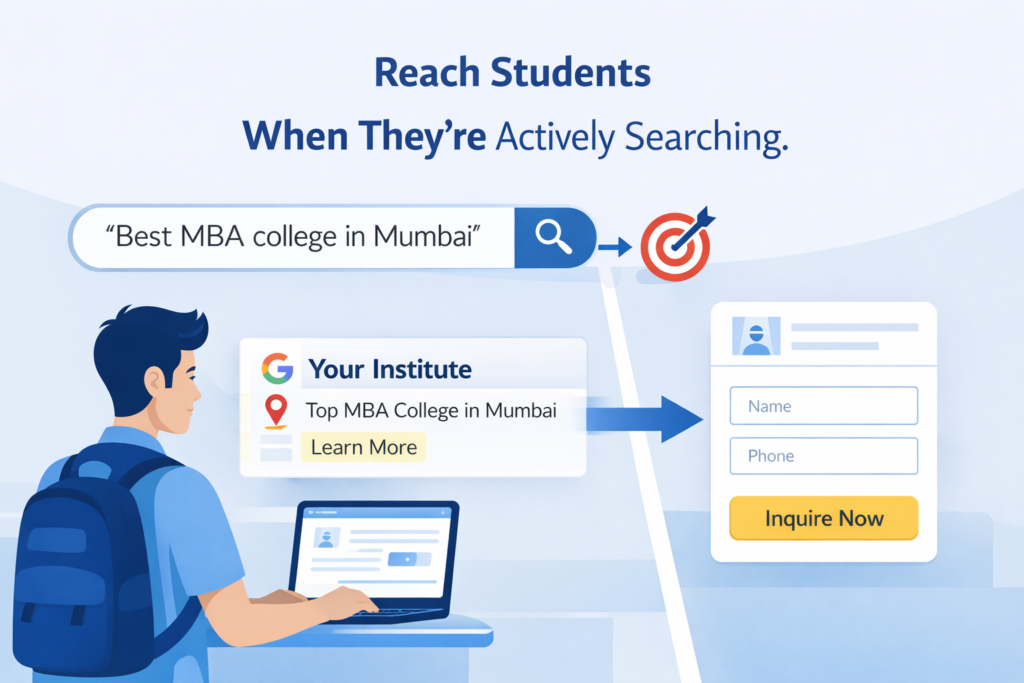
Google Ads gives educational institutes a clear advantage over traditional marketing. When students search for “MBA colleges in Mumbai” or “data science certification courses,” they’re showing high interest and actively looking for solutions right now.
Google Ads captures these prospects at this crucial decision-making moment. The platform’s local targeting lets you focus your budget on specific cities or regions where your institute operates, ensuring you don’t waste money on irrelevant audiences.
Unlike SEO, which takes 6-12 months to show results, Google Ads delivers immediate visibility. Your ads can appear on page one within hours of launch, not that it’s complete waste but it’s something that one should consider when they have other channels working for them giving the leads right now to keep their business running.
Most importantly, Google Ads provides measurable ROI. You can track exactly how many inquiries each campaign generates, what each lead costs, and which keywords bring the best quality applicants. This data-driven approach enables continuous improvement, turning your advertising into a reliable student acquisition system.
Understanding Your Target Audience
Successful Google Ads campaigns begin with knowing exactly who you’re trying to reach. Educational institutes typically serve multiple audience segments, each with distinct motivations and search behaviors.
Student demographics vary widely; a 12th-grade student researching undergraduate programs has different priorities than a working professional seeking weekend MBA classes. Understanding age groups, educational backgrounds, and career stages helps tailor your messaging effectively.
Parent decision-makers play a crucial role, especially for younger students. Parents often research course credibility, faculty qualifications, placement records, and safety aspects. They’re likely to search during evening hours and respond to messaging around ROI and career outcomes.
Course-specific searchers have clear intent. Someone searching “AutoCAD training in Ahmedabad” is further along the decision journey than someone searching “engineering courses.” Create separate audience personas for each major program you offer.
Geographic considerations matter significantly. Determine whether you’re targeting local students within your city, regional prospects from neighboring states, or national audiences for specialized programs. Your messaging, budget allocation, and keyword strategy should reflect whether you’re a neighborhood coaching center or a pan-India university.
Keyword Strategy for Education Marketing
Your keyword strategy forms the foundation of effective Google Ads campaigns. The right keywords connect you with prospects actively seeking educational solutions, while poor keyword selection drains budgets on unqualified traffic.
Course-specific keywords should form your core strategy. Terms like “digital marketing course,” “BBA admission 2025,” or “IELTS coaching” attract high-intent searchers. Layer these with different match types: exact match for precise control, phrase match for relevant variations, and broad match modifier for discovery while maintaining relevance.
Location-based targeting is critical for educational institutes. Combine course keywords with location modifiers: “MBA colleges in Mumbai,” “Python training institute Bangalore,” or “NEET coaching near Kota.” These geo-targeted keywords typically have lower competition and higher conversion rates because they match local search intent perfectly.
Branded vs non-branded terms serve different purposes. Branded keywords (your institute’s name) protect your reputation and capture existing awareness at low cost-per-click. Non-branded keywords (“engineering colleges in Pune”) drive new prospect discovery but face higher competition and costs.
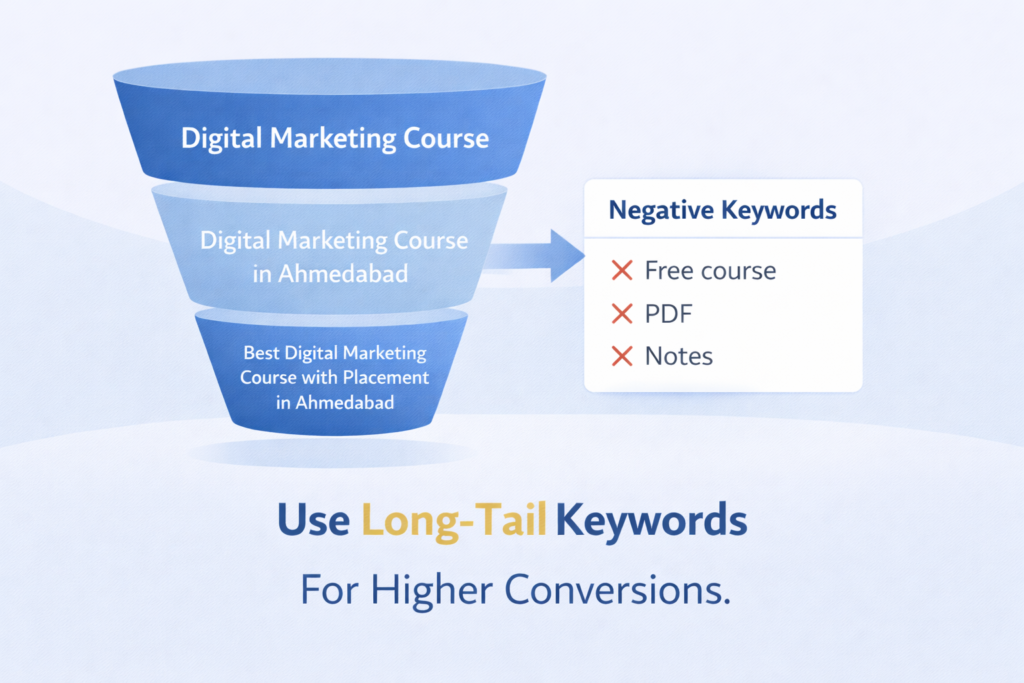
Negative keywords prevent wasted spend by excluding irrelevant searches. Add terms like “free,” “PDF,” “notes,” “syllabus download,” “government,” or “jobs” to your negative keyword list. Someone searching “free digital marketing course” likely won’t convert to a paid program. Similarly, exclude competitor names unless you’re running a competitive conquest strategy.
Long-tail opportunities offer excellent ROI. Phrases like “best digital marketing course with placement guarantee in Ahmedabad” or “weekend MBA program for working professionals in Pune” have lower search volume but attract highly qualified prospects further along the decision journey. These keywords typically cost less per click while delivering better conversion rates.
Build keyword groups around student intent stages: awareness-stage keywords (“what is data science”), consideration-stage keywords (“data science courses comparison”), and decision-stage keywords (“data science course admission 2025”). Allocate larger budgets to decision-stage keywords that drive immediate inquiries.
Campaign Structure That Delivers Results
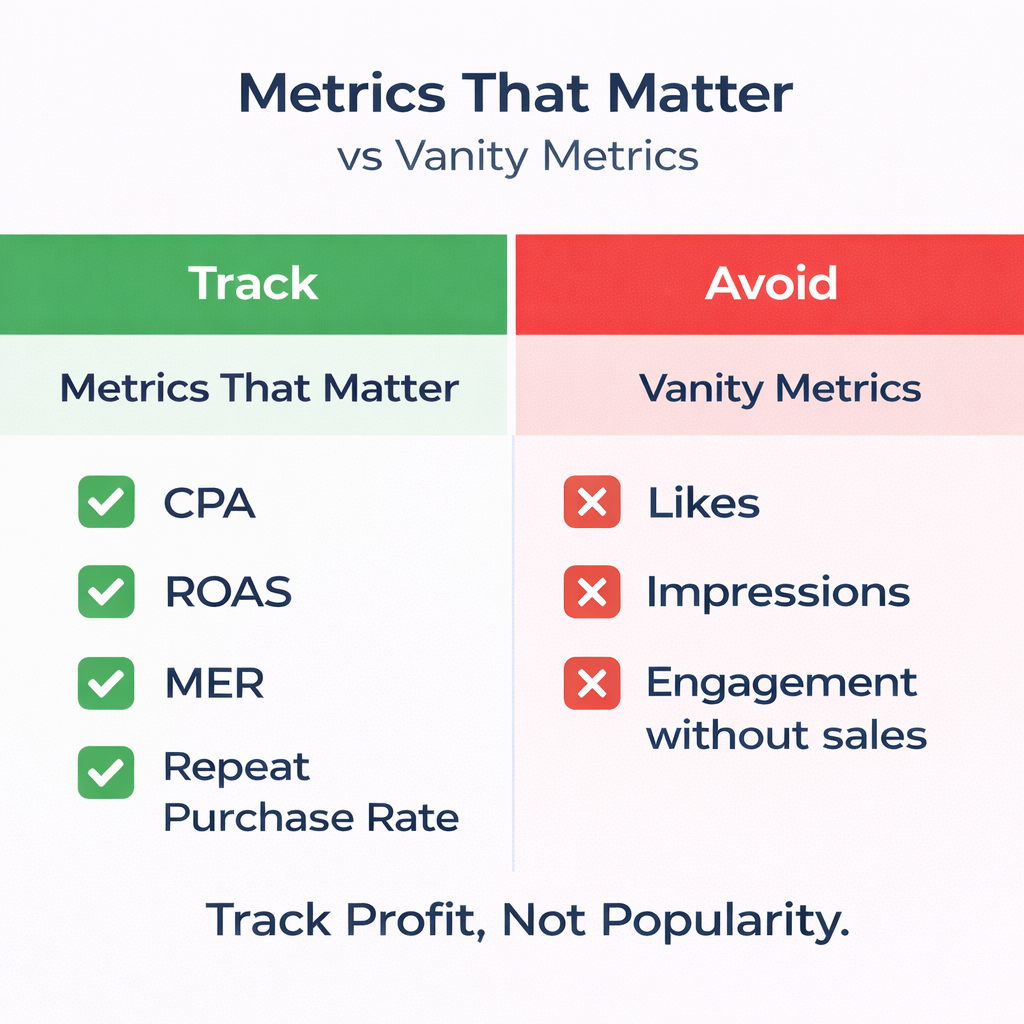
A well-organized campaign structure ensures optimal performance, easier management, and better budget control. Educational institutes should deploy multiple campaign types, each serving specific marketing objectives.
Search campaigns target high-intent queries and should form your primary lead generation engine. Structure these by course category to create separate campaigns for MBA programs, undergraduate courses, professional certifications, and skill-based training. Within each campaign, organize ad groups tightly around specific themes: one ad group for “MBA in Mumbai,” another for “executive MBA programs,” and so on. This granular structure improves Quality Scores and ad relevance, lowering your cost-per-click while improving ad positions.
Display campaigns build awareness among prospects who haven’t yet searched for your courses. Use Google’s audience targeting to reach people interested in education, career development, or specific industries related to your programs. Display ads work excellently for remarketing (discussed below) and for reaching parents browsing news sites, educational portals, or career guidance platforms. Keep display budgets moderate typically 20-30% of your total budget as these generate awareness rather than immediate conversions.
Remarketing campaigns re-engage website visitors who didn’t submit inquiries initially. Since these prospects already know your institute, remarketing typically delivers 2-3x higher conversion rates at lower costs. Create audience segments based on behavior: visitors who viewed specific course pages, those who started but didn’t complete inquiry forms, and past inquirers who haven’t enrolled. Tailor messaging to each segment offer limited-time admission discounts, highlight upcoming batch dates, or showcase student success stories.
Creating Compelling Ad Copy
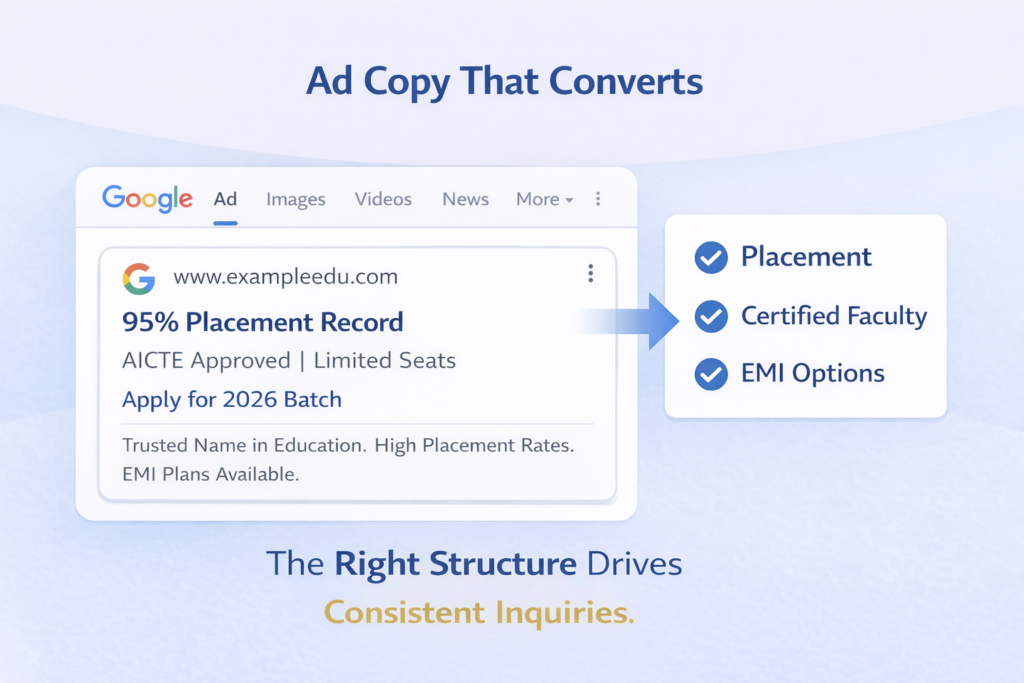
Your ad copy determines whether prospects click through to your website or choose a competitor. Effective educational ads balance information, emotional appeal, and clear calls-to-action.
Highlight your unique selling propositions prominently. If you offer 100% placement assistance, industry-expert faculty, or government-recognized certifications, feature these in headlines. Specific numbers perform better than vague claims “95% Placement Record” outperforms “Great Placements.” Showcase awards, accreditations (NAAC A+ rating, AICTE approved), or notable alumni achievements.
Address prospect pain points directly in your descriptions. Working professionals worry about time constraints and mention “Weekend Batches Available.” Budget-conscious students respond to “EMI Options Starting ₹2,999/month.” Parents concerned about career outcomes appreciate “Industry-Tied Curriculum” or “Internship Guaranteed.” Understanding your audience’s anxieties helps craft resonant messaging.
Strong CTAs drive action. Generic phrases like “Learn More” underperform compared to specific CTAs: “Download Free Brochure,” “Book Free Counseling Session,” “Apply for January Batch,” or “Check Eligibility Now.” Create urgency with “Limited Seats Available” or “Admissions Closing Soon” during peak seasons.
Ad extensions maximize visibility and provide additional information without extra cost. Use sitelink extensions to highlight different courses, callout extensions for key benefits (“Flexible Timings,” “Expert Faculty”), structured snippets for course categories, and location extensions showing your campus addresses. Call extensions with phone numbers are crucial; many prospects prefer speaking directly with admission counselors.
Landing Page Best Practices
Driving clicks to your website is only half the battle your landing page must convert visitors into inquiries. A well-optimized landing page can double or triple your conversion rates compared to generic homepage traffic.
Course details and curriculum highlights should be immediately visible. Prospective students want to know what they’ll learn, course duration, batch timings, and fees. Present curriculum in scannable formats use bullet points or module breakdowns rather than dense paragraphs. Include information about certification, examination patterns, and career opportunities post-completion.
Clear inquiry forms remove friction from the conversion process. Keep forms short name, phone number, email, and course interest are sufficient for initial contact. Lengthy forms asking for educational history, work experience, and demographic details discourage submissions. Place your primary form above the fold and consider adding a secondary form at page bottom for those who scroll through all content.
Social proof and testimonials build trust and credibility. Feature student testimonials with photos, video reviews from alumni discussing their career progression, and specific placement statistics. Showcase company logos where students have been placed. If you’ve trained 10,000+ students or have 15+ years of experience, prominently display these trust indicators.
Mobile optimization is non-negotiable over 60% of educational searches happen on mobile devices. Ensure your landing page loads quickly on smartphones, forms are easy to complete on small screens, and click-to-call buttons are prominently placed. Test your pages across different devices and connection speeds to guarantee smooth user experience.
Budget Planning and Bidding Strategies
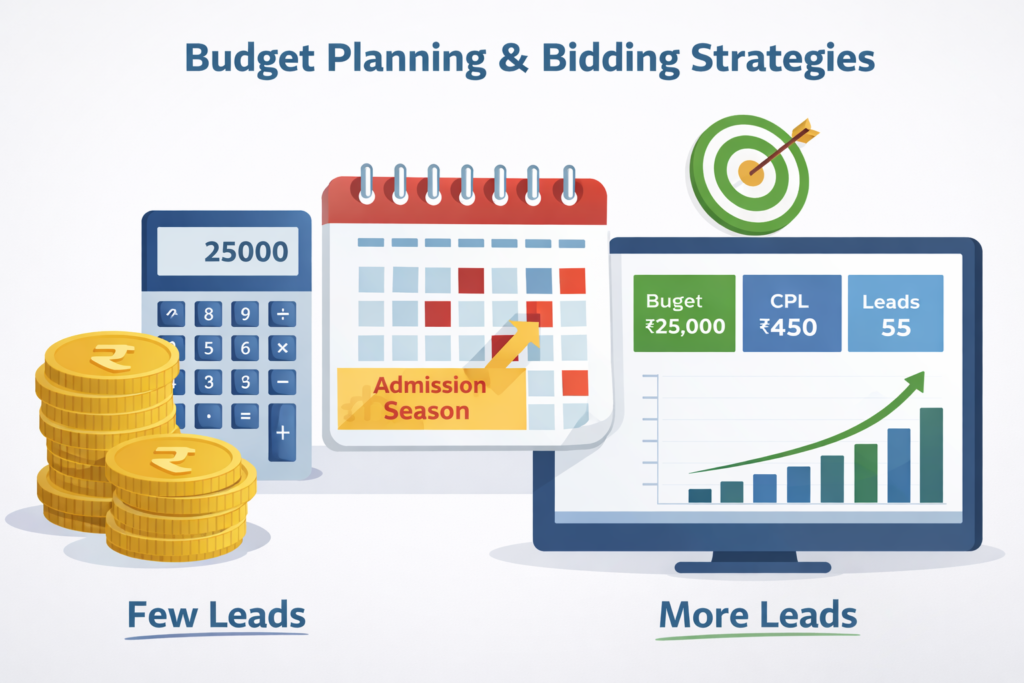
Determining the right budget and bidding approach ensures sustainable lead generation without overspending.
Setting realistic budgets for the Indian market depends on your location and competition. Metro cities like Mumbai, Delhi, and Bangalore have higher CPCs (₹20-80 per click for competitive education keywords) compared to tier-2 cities (₹10-35 per click). Start with a test budget of ₹15,000-25,000 monthly to gather data, then scale based on performance.
Cost per lead benchmarks vary by course type. Professional certification courses typically see CPLs between ₹300-800, while higher-value programs like MBA or engineering admissions might range ₹800-2,500 per lead. Technical courses often have lower CPLs (₹250-600) due to clearer intent. Track your actual CPL against these benchmarks and optimize accordingly.
Smart bidding options leverage Google’s machine learning. Target CPA (Cost Per Acquisition) bidding automatically adjusts bids to achieve your desired cost per inquiry. Maximize Conversions works well when you want to generate maximum leads within a fixed budget. Start with Manual CPC for initial campaigns to understand keyword performance, then transition to automated bidding once you have 30+ conversions monthly.
Seasonal budget adjustments are crucial for education marketing. Increase budgets 40-60% during peak admission periods (June-July for undergraduate, January-February for certifications). Scale down during off-seasons but maintain year-round presence to capture early researchers and build remarketing audiences.
Tracking and Measuring Success
Without proper tracking, you’re flying blind. Implementing robust measurement systems ensures you understand what’s working and where to optimize.
Conversion tracking setup is foundational. Install Google Ads conversion tracking code on your thank-you page (displayed after form submission) to record each inquiry. Set up multiple conversion actions: form submissions, phone calls, brochure downloads, and chat initiations. Assign appropriate values to each conversion type based on your typical enrollment rates.
Key metrics to monitor go beyond simple click counts. Cost Per Lead (CPL) tells you acquisition efficiency track this by campaign, ad group, and keyword. Conversion rate indicates landing page effectiveness; rates below 3-5% suggest page optimization needs. Return on Ad Spend (ROAS) connects advertising investment to actual enrollments. If you spend ₹50,000 and enroll 10 students paying ₹30,000 each, your ROAS is 6:1.
Call tracking integration captures phone inquiries generated by your ads. Use dynamic number insertion or Google’s call tracking to attribute phone conversions to specific campaigns. Many education leads prefer calling directly rather than filling forms, so missing call tracking means undervaluing campaign performance.
CRM integration closes the loop between inquiry and enrollment. Connect Google Ads with your CRM system to track which leads actually enrolled, their lifetime value, and quality differences between campaigns. This data refines targeting toward highest-quality lead sources.
Common Mistakes to Avoid
Avoid these pitfalls that drain budgets and reduce campaign effectiveness:
- Ignoring mobile users – Over 60% of education searches happen on mobile. Ensure mobile-friendly landing pages, click-to-call buttons, and fast load times.
- Generic landing pages for all courses – Sending MBA searchers and digital marketing prospects to the same page reduces relevance and conversions. Create course-specific landing pages.
- Not using location extensions – Students prefer nearby institutes. Location extensions display your address, distance, and clickable directions directly in ads.
- Neglecting remarketing – 95% of first-time visitors don’t inquire. Remarketing campaigns re-engage these prospects at a fraction of initial acquisition cost.
- Poor lead follow-up processes – Fast response matters. Leads contacted within 5 minutes are 21x more likely to convert than those contacted after 30 minutes. Integrate ads with CRM for immediate follow-up.
- Broad match keywords without monitoring – Broad match can waste budget on irrelevant searches. Regularly review search term reports and add negative keywords.
- Setting and forgetting campaigns – Markets change, competition shifts, and seasonal trends fluctuate. Review performance weekly and optimize continuously.
Advanced Tactics for Competitive Edge
Gain advantage over competitors with these sophisticated strategies:
Audience segmentation by course interest – Create custom audiences based on website behavior. Visitors who viewed MBA pages receive different messaging than those exploring short-term certifications. This precision targeting improves relevance and conversion rates.
Dayparting for optimal ad scheduling – Analyze when your target audience searches most actively. Students often search during evening hours (6-10 PM), while parents research during lunch breaks or late nights. Increase bids during high-conversion periods and reduce spend during low-activity hours to maximize budget efficiency.
Competitor keyword targeting – Bid on competitor institute names to capture comparison shoppers. When prospects search “XYZ Institute reviews” or “ABC College admission,” your ads can appear highlighting your differentiators. Use this tactically to avoid aggressive messaging that could backfire.
Seasonal campaign optimization – Pre-plan campaigns around academic calendars. Launch awareness campaigns 3-4 months before admission deadlines, shift to conversion-focused messaging as deadlines approach, and deploy urgency-based ads in final weeks (“Last 5 Days to Apply”).
Case Study: Dipti Shah’s Institute – From Newspaper Ads to Digital Lead Generation
About the Client:
Dipti Shah’s Institute, established in 1981, is one of Ahmedabad’s most respected training centers for English speaking, public speaking, and self-development. Despite four decades of experience, they faced a critical challenge.
The Challenge:
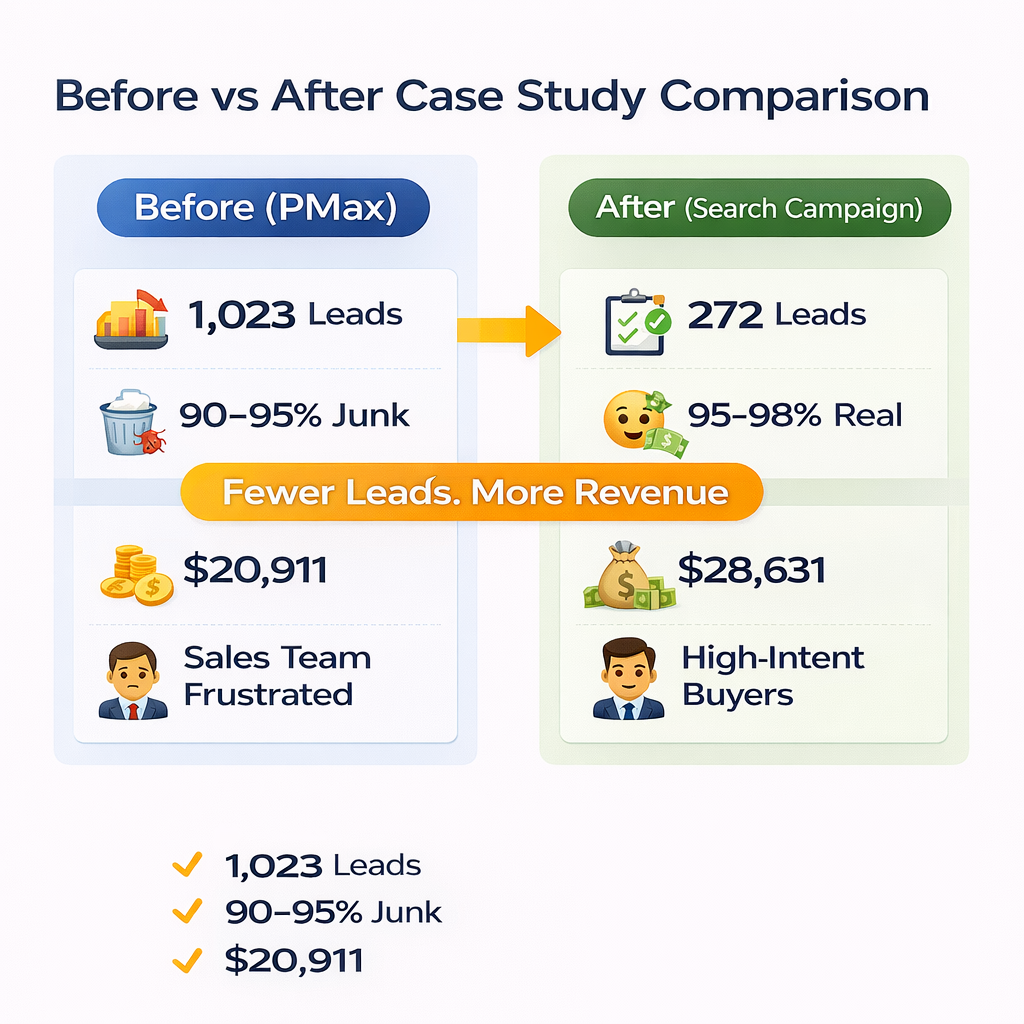
Newspaper advertising results had dropped sharply. Previous digital marketing attempts with multiple agencies and freelancers delivered irrelevant leads, outdated databases, and poorly structured campaigns. They needed genuine, conversion-ready inquiries from graduates, post-graduates, and working professionals.
Our Strategy:
We built a complete performance marketing foundation from scratch:
- Conducted detailed audience research based on demographics and career interests
- Analyzed past offline data to identify high-performing geo-areas in Ahmedabad
- Launched Meta campaigns targeting public speaking and personality development interest groups
- Created Google Search campaigns for high-intent queries like “English speaking classes in Ahmedabad”
- Continuously optimized targeting to eliminate budget waste
The Results:
- Relevant inquiries started flowing from week one
- Meta Ads delivered leads below expected cost range
- Google Search became the strongest channel with highly conversion-ready prospects
- Established consistent digital lead flow through WhatsApp, calls, and email
- Successfully replaced unreliable newspaper ads with predictable digital inquiry generation
Conclusion
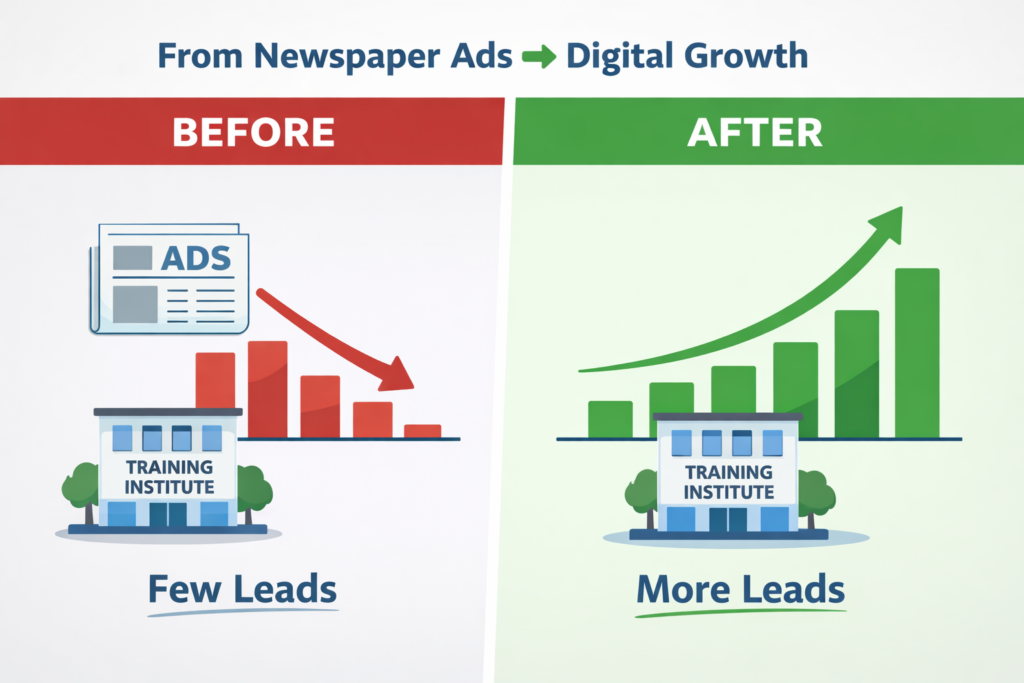
Google Ads transforms educational institutes from relying on unpredictable seasonal admissions to enjoying consistent, year-round inquiry generation. By implementing the strategies outlined targeted keywords, optimized campaigns, compelling ad copy, conversion-focused landing pages, and data-driven measurement you create a scalable student acquisition system that grows with your institute.
Success requires continuous optimization. Monitor performance weekly, test new approaches, refine targeting based on results, and adapt to changing market dynamics. The institutes that treat Google Ads as an ongoing strategy rather than a one-time setup consistently outperform competitors.
Ready to transform your admissions process? Our agency specializes in the education sector PPC with proven results across coaching centers, training institutes, and colleges throughout India. Let’s build your predictable lead generation engine.
Frequently Asked Questions
What is the average cost per lead for educational institutes in India?
Cost per lead varies by location and course type. Metro cities see CPLs between ₹500-2,500 for premium programs like MBA or engineering, while professional certifications range ₹300-800. Tier-2 cities typically have 30-40% lower costs due to reduced competition.
How long does it take to see results from Google Ads?
You’ll see initial clicks and impressions within 24-48 hours of launch. Meaningful lead generation typically begins within 2-4 weeks as Google’s algorithms optimize delivery. Full campaign maturity and optimal performance usually occur after 2-3 months of continuous optimization and data collection.
Should we target both students and parents?
Absolutely. For younger students (undergraduate programs), parents are primary decision-makers and respond to messaging around ROI, safety, and credibility. For professional courses and postgraduate programs, target students directly with career advancement and skill development messaging. Create separate ad groups for each audience.
What’s the minimum budget needed to start?
Start with ₹15,000-25,000 monthly for single-location institutes in tier-2 cities. Metro areas require ₹25,000-50,000 minimum for competitive visibility. This allows sufficient data collection for optimization. Scale budget once you identify profitable campaigns and understand your cost-per-enrollment economics.
How do we compete with larger institutes?
Focus on niche differentiation and hyper-local targeting. Target long-tail keywords larger competitors ignore, emphasize unique benefits (personalized attention, flexible timings, specialized faculty), use location extensions to highlight proximity advantages, and leverage remarketing to stay top-of-mind at lower costs than broad acquisition campaigns.