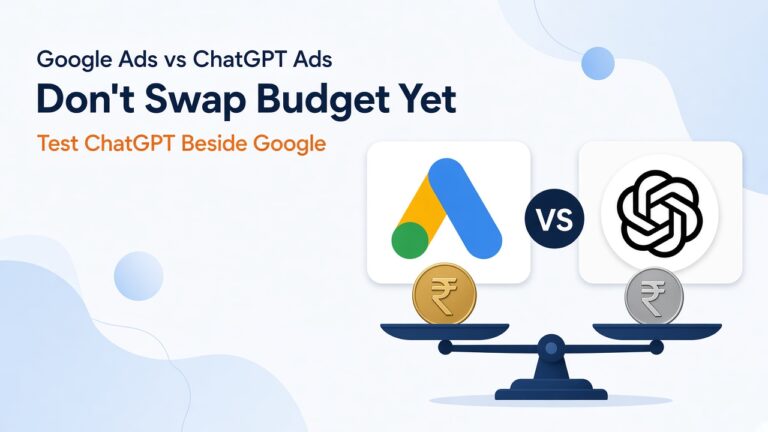
Google Ads still captures people who are already in buying mode: transactional traffic, the kind that types a product, a service, or a city plus a supplier. ChatGPT Ads are a newer, labelled unit after an answer. They fit better when someone is still in the research phase, with informational intent, than when they are ready to pay.
This Google Ads vs ChatGPT Ads briefing is for Indian D2C and lead-gen teams, including shops like ours in Ahmedabad. You’ll see what is verified in India today, how the channels differ, and how we would test spend without hurting a working search account. Official rules change, so confirm Ads Manager and the help pages when you buy.
Quick Summary:
Use Google Ads when the user is in buying mode (transactional traffic). Use ChatGPT Ads when the user is in the research phase (informational and research intent), as a controlled test if your entity can buy in India. Paid units do not change ChatGPT’s answers. Keep proven search funded while you test, and check live Ads Manager rules before you spend.
What ChatGPT Ads Can Do Today
ChatGPT Ads are not a mysterious kind of organic mention. They are paid, labelled units that can appear after a reply for eligible users, in markets where OpenAI has opened buying. Before you shift any search money, get clear on who sees those units, and who can buy them from India.
Who Sees Ads And Who Does Not
OpenAI’s help pages say ads may appear for logged-in adult users on the Free and Go plans in regions where the product is rolling out. Plus, Pro, Business, Enterprise, and Edu plans do not show these ads. If your buyer is a finance head on a paid ChatGPT plan, they may never see the unit you just built.
Ads are clearly labelled and separate from the model’s reply. OpenAI states that advertising does not influence the answers ChatGPT provides. If you have been wondering, do ChatGPT Ads influence ChatGPT answers? The official position is no. Buying a unit does not write your brand into the reply or count as an organic citation.
India Access Formats And Buying Paths
If the question in your team chat is, are ChatGPT Ads available in India, here is the useful answer. Self-serve buying opened for India on 31 August 2026, and India is listed as available in OpenAI’s Ads Manager availability table. Self-service buying requires that the legal entity billed is based in a country on that list. Confirm the live table, because it can change.
As of February 2026, OpenAI said India was home to more than 100 million weekly ChatGPT users. That is a reach figure from that announcement, not a later 2026 update, and not a reason by itself to move search budget. Can I run ChatGPT Ads in India if my billing country sits elsewhere? Check the legal-entity rule and the live availability page before you assume yes.
Buying runs through Ads Manager and partner or OpenAI sales routes. Objectives include Views, Clicks, and Conversions. OpenAI’s help pages recommend a starting bid of $3 to $5 USD per click, which is USD bid guidance, not an India rate card, so don’t treat it as your rupee cost per click.
Why Google Still Captures Ready Demand
Search remains the default performance channel for a plain reason: a typed query often arrives when someone already wants a thing done. This is not another Google Ads walkthrough. What follows is why, in a ChatGPT Ads vs Google Ads argument, we would still fund proven search.
Search Queries Signal Purchase Readiness
Typed queries often show a person already looking for a product, service, or supplier. That is search intent in the ordinary sense, not a textbook definition. Contrast that with a looser research chat. Someone Googling “CA in Ahmedabad” is closer to hiring; someone asking ChatGPT how to pick an accountant is still comparing. The example is illustrative, not a case study.
When those high-intent queries already convert on a tracked landing page, that demand still deserves budget.
Controls That Help You Optimise Spend
Marketers already know the Google toolkit: keywords and negatives, device and location bids, asset tests, conversion imports, and Smart Bidding once enough data exists. That is why search is easier to steer, week to week, than a new conversational unit.
ChatGPT buying gives you a thinner set: advertiser hints, locations, platforms, and audiences. More controls do not automatically mean cheaper leads, though they do help you diagnose a Google issue with more precision.
Why This Stays The Default Channel
For most Indian D2C and lead-gen accounts, proven search demand should stay funded while a new channel is tested beside it, not instead of it. At HND, the usual advice is to protect the channel that already produces qualified, store-confirmed or CRM-confirmed results.
Measurement maturity plays a part: the tracking history you already trust, Search term insights, and a longer bidding record.
How ChatGPT Reaches People Mid Research
Picture a shopper in Surat comparing mid-range skincare, or a working professional asking how a weekend course is structured. They are not filling a payment form yet. They are thinking out loud. Conversational advertising is built for that earlier moment, after the answer, which is a different job from capturing a typed brand or “buy” query.
Ads Sit After The Answer
Placement is one labelled unit after the answer, separate from the model output. These are sponsored placements, not a recommendation inside the reply. Buying ads does not make ChatGPT recommend the brand in the answer, and it does not replace the work of earning organic mentions or citations.
Early overseas tests, if you mention them at all, are not India proof. We wouldn’t quote someone else’s revenue-per-visit study as your baseline.
Context Hints Are Not Keywords
A fair question is how does ChatGPT Ads targeting work, when there is no classic keyword list. OpenAI says delivery can use the current chat, the landing page, title, copy, advertiser-provided context hints, and targeting selections. Hints guide matching. They are not exact-match keywords, and they do not guarantee a given chat.
Write hints around problems, categories, and who the offer is for, in plain language, then pair them with a landing page that matches the promise. Don’t treat the hint box like a keyword dump.
Compare Both Channels In One View
People often want a single grid so they can brief a founder in one sitting. Read the table as a snapshot of how the channels differ today, not as a scorecard with a winner. Where a ChatGPT detail varies by market, confirm it in Ads Manager rather than guessing.
| Point of comparison | Google Ads | ChatGPT Ads |
| User intent | Buying mode (transactional traffic) | Research phase (informational and research intent) |
| Placement | Search and other Google surfaces you already use | One labelled unit after the answer, separate from the model output |
| Matching | Keywords, audiences, and other Google controls | Conversation context and advertiser hints, not exact-match keywords |
| Creative | Search ads, assets, and formats you already run | Title and copy in a labelled unit; confirm formats in Ads Manager |
| Buying and bids | Auction bidding, budgets, and usual Google bid tools | Views, Clicks, or Conversions; $3 to $5 USD starting-bid guidance is not an India rate card |
| Measurement | Tracking, Search term insights, bidding history | Ads Manager reporting; spend insights may be delayed 7 to 8 hours |
| Who can see it | People reached by your Google targeting | Logged-in adults on Free and Go; Plus, Pro, Business, Enterprise, and Edu are ad-free |
| India access | Advertisers who meet Google’s India account rules | Self-serve from 31 August 2026, subject to legal-entity rules; confirm live availability |
| Best-fit role | Primary for buying mode and existing search demand | A test for research-phase conversations, not a replacement |
The best-fit row is the one we would actually brief. Don’t treat the grid as the whole article.
Decide Where The Next Rupee Goes
A founder or performance lead usually needs one of three calls: hold search as it is, run a small ChatGPT test beside it, or wait. We treat that as practice, not a universal law, and we wouldn’t give you a fixed percentage split as a rule. So can ChatGPT Ads replace Google Ads? For a working Indian search account, that is not the plan we would brief.
When Google Ads Should Stay Primary
Use Google Ads when the user is in buying mode (transactional traffic). Stay primary when search already produces qualified leads or orders on contribution, tracking is clean, and the offer or site still has headroom.
If query volume is healthy and the limit is conversion rate or fulfilment, fix that before adding a new paid surface. At HND, we would not starve a working search account to “be early” on a new unit.
- Keep Google funded if it already pays on contribution.
- Fix the site or the offer before you buy a new surface.
When A ChatGPT Test Makes Sense
Use ChatGPT Ads when the user is in the research phase (informational and research intent), as a test beside Google, not a swap. A test can make sense when the legal entity can buy in India, the category is allowed, conversion tracking is ready on the landing page, and the buyer often researches in chat before they search a brand name.
Hypothetical, not a client story: a D2C brand whose category is compared at length, or a lead-gen service people ask advice about before they type a city plus service query. Keep the test budget separate, small enough that a weak week does not break cash flow, and look ahead to the official India minimum of around ₹700 a day in the next section. Don’t invent a recommended monthly figure. And no, we wouldn’t bet the plan on low competition lasting.
For lead gen, ChatGPT Ads vs Google Ads for leads is not a like-for-like contest. Google still tends to catch the late query. ChatGPT, when it works, is earlier. Judge both on qualified enquiries, not form fills alone.
When You Should Wait Or Skip
Wait or skip if tracking is messy, the offer is weak, stock or sales follow-up cannot absorb new leads, the category is restricted, or the likely buyer lives mainly on an ad-free ChatGPT plan. Restricted categories are not a place to improvise. Open OpenAI’s ads policies and confirm the current rules at the time of writing. An unofficial blog list is not a substitute for that page.
Brand safety sits inside that same check. Waiting is a valid professional choice. Between us, waiting looks less glamorous than launching, and it is often the adult move.
Run A Tight ChatGPT Ads Test
If the brief is how to test ChatGPT Ads safely, start on paper, not in the bid field. Keep one objective, a stop rule, and a window you will honour, then judge the result against Google, not against a mood.
Set Guardrails Before You Spend
On the ChatGPT Ads minimum budget in India, treat the official floor as around ₹700 a day (roughly ₹700 to ₹750). OpenAI’s campaign help lists minimums by billing currency. Write an approximate amount, not the exact table figure, and confirm the live minimum table on that help page, because minimums can change. Daily spend may go up to twice the daily budget on a single day, and seven-day spend should not exceed seven times the daily budget.
Before you launch, run a simple pre-flight: eligible India entity and billing complete, an allowed category, a landing page with events and UTMs ready, and a pixel or Conversions API hook if available when you buy. Set a hypothetical rupee envelope for a few weeks at a daily amount the brand can afford to lose. Write the hypothesis, the observation window, and the result that means pause. Don’t present $25 USD, or any unofficial “around ₹700 a day and you are done”, as the whole cost of a useful test. Media, creative, and landing work sit on top.
Judge Results Against Google Benchmarks
Use a short written sequence and then stick to it.
- Pick one offer already proven on Google, with clean tracking.
- Launch ChatGPT with one objective, tight hints, and no other major media edits that week.
- Log spend, clicks, qualified leads or store orders, and cost per qualified result in rupees.
- After a full agreed window, compare incremental quality with the Google baseline, not with vanity CTR alone.
Spend insights may be delayed 7 to 8 hours, so a displayed spend of zero does not necessarily mean nothing was charged. Reporting times can vary. We’ve all stared at a zero-spend row on a new chatgpt ads campaign and assumed the worst. At HND, we would keep Google running as the control. A three-day glance is not a verdict, and a US study ROAS is not an Indian benchmark.
Judge Quality With The Same Yardstick
Clicks are easy to celebrate and expensive to misunderstand. A ChatGPT click after a research answer is not automatically a ready buyer. Use the same quality bar you already trust on Google: qualified results, and the money left after the messy costs of doing business in India.
Track Qualified Leads And Real Payback
For lead gen, judge qualified enquiries and show-up or close rate, not form fills alone. For D2C, judge paid, confirmed orders and contribution after discounts, COD failures, and returns, not add-to-carts. If you already review paid media on a tight metric set, keep using that discipline here too. We have written about the metrics we use to judge a PPC campaign.
Don’t invent a tidy return story from a short window. If the qualified cost is worse than Google and quality is no better, pause. If quality looks stronger and you can afford the test envelope, continue, still without cutting search.
Pick Your Next Media Move
Keep Google on proven demand, for buying mode and transactional traffic. Treat ChatGPT Ads as a measured test for the research phase, informational and research intent, if you are eligible. Do not buy ads expecting them to change ChatGPT’s answers.
Confirm India account eligibility and tracking, then either wait or write a short test with a stop rule. HND can help review your Google Ads structure or a ChatGPT Ads test. Related reading: our Google Ads service, our ChatGPT Ads service, and the PPC metrics guide above.
Test ChatGPT beside Google. Don’t swap the budget yet.
FAQs:
Are ChatGPT Ads billed in rupees?
Yes, if your Ads Manager billing country is India and you pay in INR. The official daily minimum is around ₹700 a day (roughly ₹700 to ₹750). Confirm the live minimum table on OpenAI’s campaign help page, because minimums can change.
Can service businesses run ChatGPT Ads?
Yes, if the legal entity can buy in India, the category is allowed, and tracking is in place. A CA firm, coaching institute, or clinic can test, provided the offer and follow-up can absorb new enquiries. Confirm category rules on OpenAI’s ads policy page before you spend.
Will ads show in the ChatGPT app?
They can. Official placement covers the ChatGPT apps and web on Android, iOS, and desktop. Ads may appear for logged-in adult users on Free and Go. People on Plus, Pro, Business, Enterprise, or Edu plans do not see these ads, which matters if your buyers pay for ChatGPT.
Do I need a landing page ready?
Yes. Send clicks to a page that matches the promise in the ad, with a clear next step and working tracking. A weak page wastes the test. Have UTMs and your event, form, or purchase tracking ready before the campaign goes live.
Can I target only Hindi conversations?
OpenAI’s public help pages do not document a Hindi-only conversation target. You can write hints and copy in the language your buyer uses, and set location targeting where it is available. Confirm current language controls in Ads Manager at the time you buy.
Are ChatGPT ad clicks usually cheaper?
There is no official India proof that ChatGPT clicks cost less than Google. OpenAI’s starting bid guidance of $3 to $5 USD per click is USD guidance, not an India rate card. Compare cost per qualified lead or order against your own Google baseline, not against a global rumour.
Can I use the same Google creatives?
You can reuse the offer and proof, but don’t paste a search ad and hope. ChatGPT units sit after an answer, so the title and copy should fit a research moment, not only a keyword. Check current creative formats and specs in Ads Manager before you upload.
What if my category is restricted?
Don’t improvise. Open the official OpenAI ads policies and confirm whether your category can run at the time of writing. If it is restricted or needs extra review, wait or skip. An unofficial blog list is not a substitute for the live policy page.
How long should a trial campaign run?
Run a full agreed window, not a three-day glance. Keep Google on as the control, change as little else as you can, and allow for spend insights that may be delayed 7 to 8 hours. Then compare qualified results with the Google baseline.
Does a ChatGPT click mean purchase intent?
Not by itself. A click after a research answer often signals interest, not a ready buy. Treat it as earlier-funnel unless your landing page and sales notes show otherwise. Judge qualified enquiries, show-ups, or paid orders, not click-through rate alone.