
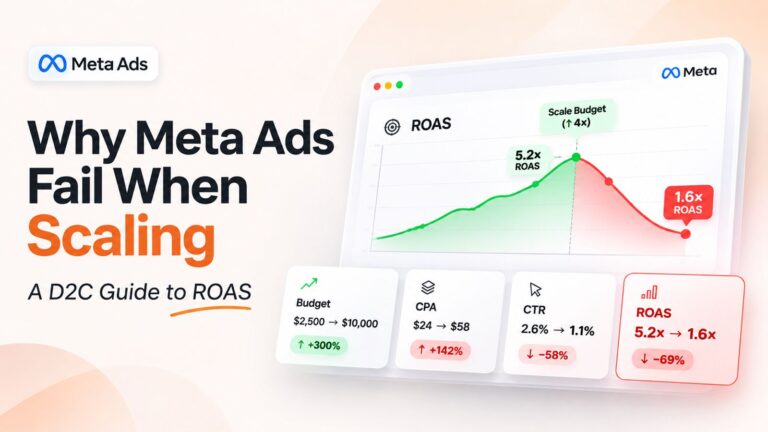
You raise daily budget. ROAS slips. Cost per purchase climbs. Nothing “broke” in the sense of a bug, yet the account stops behaving like it did at the old spend.
Cheap conversions get used early. Learning can reset. One creative ends up carrying most of the money. Or your store conversion and margin simply can’t support a dearer click. That’s often why return falls once spend rises, even when last week’s dashboard looked fine.
You’ll leave with a way to tell a normal efficiency slide from a fixable mess, and a paced test tied to contribution. Honestly, most brands scale too early. The aim is profitable growth, not a prettier daily budget number.
Meta Ads ROAS often falls during scaling because additional spend reaches more expensive or less responsive audiences. Learning resets, creative fatigue, conversion rate limits and fulfilment issues can make the decline worse. The best way to scale is to track marginal ROAS, protect contribution margin and increase spend through controlled tests.
Why Efficiency Falls As Spend Rises
Raising spend doesn’t buy more of the same cheap results. You’re buying the next available chances in the auction. Those are often slower, colder, or just dearer. The drop feels sudden in Ads Manager. The cause is usually ordinary delivery maths plus a few avoidable resets.
Cheap Opportunities Run Out Over Time
Delivery tends to use easier, lower-cost chances early. Spend more and you reach people who need more convincing, or who cost more to reach. Cost per result climbs, and no bug is required for that to happen.
This is one reason Meta Ads can struggle as brands increase spend: they assume the same average ROAS will hold at a higher budget. Meta doesn’t publish a safe percentage that says efficiency must fall by X. Rising costs after a step are a tendency to check, not proof the channel is dead.
Quick hypothetical (not a client number). Week A: ₹30,000 spend, 3.0 ROAS. Week B: ₹60,000 spend, blended ROAS 2.4. The extra ₹30,000 only brought about ₹54,000 attributed revenue. Increment = 1.8. The average still looks “okay” if you squint. The added rupees don’t. Do the maths on your own two weeks before you yell at the algorithm.
Learning Resets Can Mimic Account Failure
Big edits can shove an ad set back into learning. Meta says that during the learning phase, performance is less stable, so costs then aren’t a clean guide to later results.
Changing creative, targeting, or the optimisation event, or pausing for a long stretch, can count as significant edits. Budget jumps may or may not, depending on how large they are.
Stack a raise every three days and you can stay noisy for weeks. Looks like failure, though often it’s unfinished learning. And reading hourly ROAS while Ads Manager still shows Learning Limited? That’s how you invent a crisis.
Read The Right Numbers Before Raising Spend
The scoreboard you pick decides whether you keep spending or pull back. Blended platform ROAS alone can hide a losing increment. Agree which numbers decide the call before you touch budget again. Give them time to mature on store data you trust.
Separate Blended Return From Incremental Return
Blended ROAS = total attributed revenue ÷ total ad spend. Marginal ROAS = return on the added spend alone. Once you separate those two views, a soft average stops looking like proof the next rupee works.
MER (total store revenue over all media) sits next to those views. So does new-customer CAC on the weekly review, so prospecting quality doesn’t hide behind returning buyers.
| Metric | What it answers | Weakness if used alone |
| Blended ROAS | Total attributed return on ad spend | Hides a losing increment |
| Marginal ROAS | Return on the extra spend only | Needs two clean periods |
| Cost to win a new buyer | Acquisition cost for buyers new to the brand | Ignores contribution if costs are incomplete |
| MER | Store revenue versus all media | Soft on channel diagnosis |
If blended ROAS looks calm while the increment worsens, the step didn’t pay for itself.
Tie Spend Limits To Contribution Margin
Start from money left after discounts and refunds. Subtract product, fulfilment, payment fees, expected returns / RTO. What’s left can fund ads.
That leftover is the contribution you can spend on ads. It sets break-even ROAS: order value ÷ contribution per order. Advertising-only CAC can look cheap. Fully loaded CAC, after COD failures, often doesn’t. Judge scale on the loaded view even when Ads Manager is still smiling.
Wait For Attribution And Delivery To Mature
India D2C adds lag you can’t wish away: COD confirmation, RTO, and return windows mean revenue and cost move after the click day.
Attribution lag means one noisy Tuesday is a weak reason to kill a step. Read a full week at campaign level. Then reconcile against store orders once delivery has settled. Brands that skip the wait often “fix” problems they created with impatience.
Spot What Broke In Your Account
Results slipped after a raise. Guess less, and match what you see to a likely cause before you open the edit history. The table is a hypothesis aid, not a verdict machine, so walk it once before you touch budgets again.
Match Symptoms To Likely Causes Quickly
| What changed | Likely cause | Where to look | Opening action |
| Costs jump after a big edit | Learning reset | Learning status, edit history | Hold edits; wait for enough events |
| One ad eats most spend | Spend piled on one asset | Ad-level spend share | Prepare distinct concepts before the next step |
| CPM up, site CVR flat | Dearer auction inventory | CPM, CPC, CVR by week | Check creative and audience headroom |
| Frequency up, CTR down | Reach not rising with spend | Reach vs spend, frequency | Widen delivery or refresh creative |
| CPC up, store CVR down | Conversion ceiling | Device CVR, checkout drop-offs | Fix the site before buying more clicks |
| Ads Manager and store disagree | Tracking gap | Pixel, CAPI, order match | Reconcile events before judging ROAS |
You’ll see creative concentration and audience saturation show up in real accounts. Treat both as hypotheses tied to what you can open in Ads Manager, not as slogans.
Avoid Cutting Winners On Day Two Panic
Hold the previously profitable setup while you confirm lag and concentration. Pausing a winner on incomplete data often forces another learning reset, and then next week is even harder to read. Patience here is operational, not sentimental.
Fix Constraints Before Adding More Budget
Budget is a poor fix for a broken constraint. Clear the bottleneck that’s actually binding. Then spend into a system that can absorb volume. Skip this and you’ll rediscover the same leak at a higher daily rate. Sometimes the ad account looks busier than the warehouse. That’s your clue.
Rebuild Creative Supply With Distinct Ideas
One asset carrying most of the budget? You’re one tired hook away from a cost spike. Creative fatigue hits harder once spend rises, because the same people see the same idea more often.
Cosmetic headline swaps rarely count as new supply. Get two or three materially different angles ready before the next step. Aim for a different problem, format, or proof, not a new font on the same flat lay.
Widen Delivery Without Ignoring Fulfilment Reality
Broader audiences and placements can open cheaper opportunities. Cheap traffic from pincodes you can’t serve is still wasted spend. Check failed-delivery rates, stock depth, courier SLA before you celebrate a lower CPC. A cheap click that becomes an RTO isn’t a win on the P&L.
Raise Conversion Rate When Clicks Get Dearer
Cost per customer roughly tracks click price ÷ conversion rate. Clicks get dearer and a soft site becomes the ceiling. Checkout friction? Fix that path before you buy more traffic. Don’t expect ads to paper over a weak product page.
Clean Measurement Before Judging The Next Step
Pixel events, Conversions API deduplication, and store reconciliation decide whether the ROAS you trust is real. Cleaner signals help decisions, though they don’t, by themselves, make customers cheaper. Fix tracking before you rewrite strategy on bad data.
Run A Controlled Budget Increase Test
“Scale carefully” helps nobody. A written test does. Treat a budget raise as an experiment with a stop rule, not a mood. Write the plan down before you hit publish.
Write The Hypothesis And Guardrails Up Front
Write down the baseline week, the hypothesis, stock and cash limits, the observation window, and the result that sends you back. Change one major lever at a time.
A step-by-step budget increase gives you clearer results than changing creative, audiences and spend in the same week.
- Pick a campaign already past unstable learning and clearing your contribution floor on store-confirmed orders.
- Size the step so you can afford to be wrong in rupees, and so weekly optimisation events stay in a workable range.
- Publish the change, then leave targeting, creative, and bid strategy alone for the observation window.
- Log date, budget, blended ROAS, marginal ROAS, store orders, and conversion rate.
Judge the Increment Over a Full Week
Read campaign-level results across a full week. Prefer the return on the extra spend over a single daily ROAS snapshot.
Meta recommends choosing a conversion that happens about 50 times per week at a minimum when you maximise conversions, because the system needs enough events to learn (Meta Business Help Centre: https://www.facebook.com/business/help/197634954160445). That’s a volume guide for learning, not a law that every objective must hit 50 purchases. And only events inside your attribution window count.
If the increment clears your floor, hold steady before the next step. If it doesn’t, step back and name the constraint.
Protect Stock Cash And Fulfilment Capacity
Ads aren’t the only bottleneck. A clean account still fails if ops can’t keep up. Treat capacity as a gate equal to creative and margin.
Confirm Inventory And Delivery Can Absorb Volume
Check stock on promoted SKUs, packaging capacity, courier SLA, and support load. Scaling into stockouts trains the algorithm on refunds and bad reviews.
Dull work, but necessary before you raise spend again.
Set A Cash Buffer For Payback Timing
COD delay, returns, and discounting change when cash arrives. Accept a longer payback only when cohort data and cash on hand support it. Paper ROAS that arrives three weeks late can still starve payroll. Finance and media need the same calendar. Or someone gets a nasty surprise mid-month.
Keep Festive Peaks From Forcing Panic Edits
Diwali and sale weeks raise auction pressure. Prepare creative and stock before the peak. Mid-sale rebuilds often reset learning when you can least afford noise. Plan the peak like a launch, not like a surprise that hit your phone at 11pm.
Decide to Hold Scale or Pull Back
Once the test week is done, pick one path. The call is about the increment and the constraints, not pride in a higher daily budget. Write the choice in the same log you used for the test.
Hold or Scale Using Incremental Return
Hold when the added rupees still clear break-even after costs and nothing operational is creaking. Scale when creative supply, CVR headroom, and fulfilment can support the next step. That’s the practical core of scaling D2C ads profitably without pretending every account follows the same percentage ladder.
Pull Back When Extra Spend Breaks Contribution
Increment breaks contribution? Step down to the last profitable level and fix whatever constraint broke the increment. Diversify channels for a defined job, not because Meta felt expensive for one week. Knowing when to stop raising paid spend is part of running a grown-up media plan.
Still shaky on tracking, offer, or fulfilment? Pause the scaling plan. Tighten the base before you buy more traffic. A readiness check is cheaper than buying the same leak at 2× spend.
Confirm the metric that decides the call, clear the real constraint, then run one controlled spend step and judge the increment on matured store numbers.
That’s how you grow ecommerce ads without giving up profit over time. There’s no magic daily budget, so keep the log honest. The next step gets easier when the last one is written down.
Want another pair of eyes on structure before the next raise? Our Meta Ads service is built around tracking, creative testing, and paced scaling. Still building foundations?
Our note on when an ecommerce brand is ready for paid ads is a useful check before you spend more.